
Last updated: August 15, 2026 | By Lawrance | This guide explains the 21+ age rule, ID checks, KYC, shared-device risks and underage account issues for Philippines casino readers.
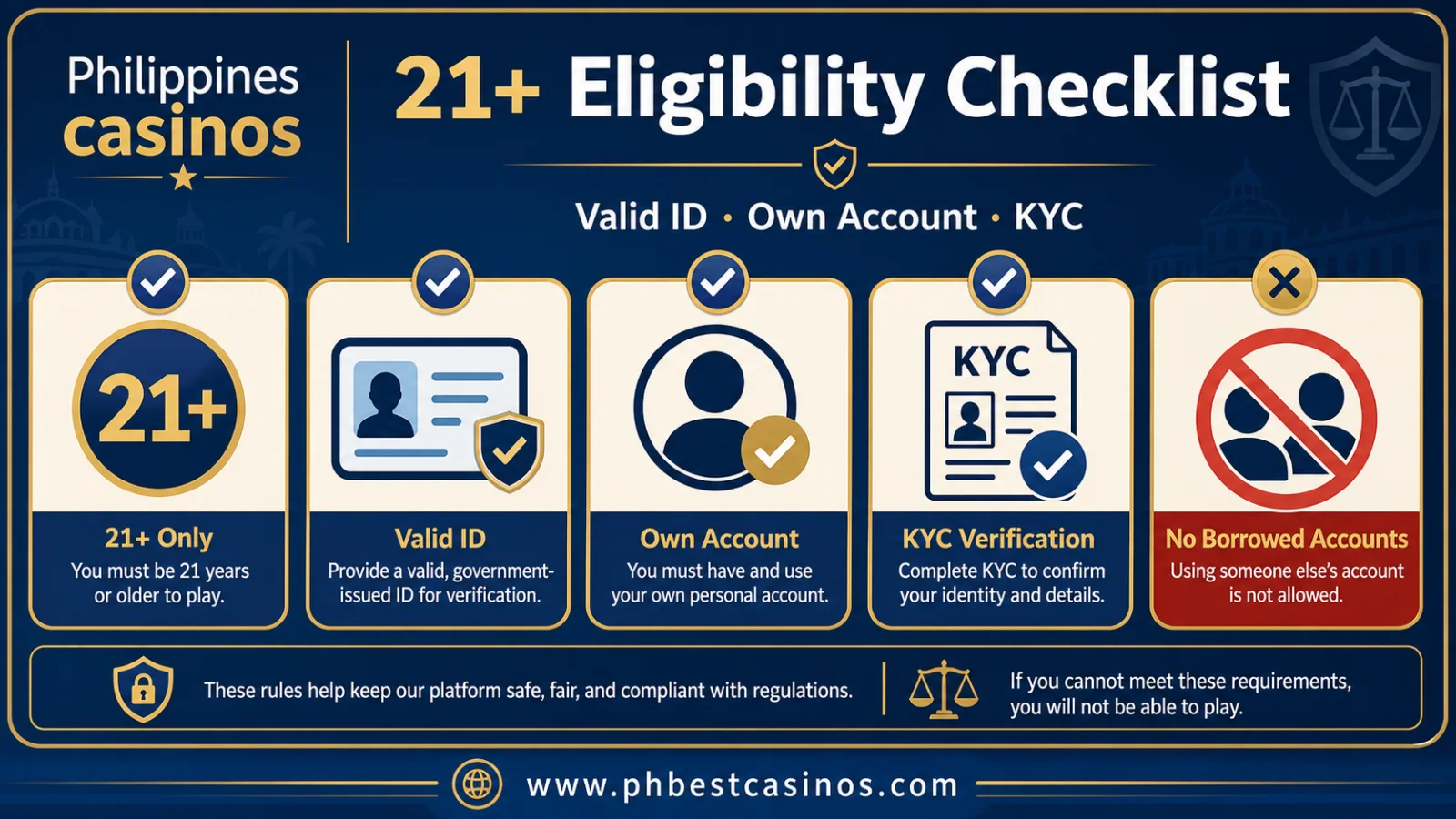
The practical answer is simple: real-money casino play in the Philippines should be treated as 21+ only. A reader should not register, deposit, borrow an account, lend an account, or use a family member’s wallet unless the account holder is eligible and can verify their own identity.
Quick answer: before opening a casino account, confirm that you are at least 21 years old, use your own legal name, use your own payment method, keep a valid government ID ready, and understand that KYC may be checked before withdrawals or during account review.
Why the Age Rule Matters
Age checks are not only a sign-up formality. They affect account approval, withdrawals, responsible gaming records, family device use, and complaint handling. If a casino account is later found to involve an underage user or mismatched identity, the case can become harder to resolve because the operator must review eligibility, payment ownership and account history together.
Current search results for this topic mostly answer the age number and registration requirement. The missing part is what readers should do before money enters the account. This article focuses on the decision sequence: age first, identity second, payment ownership third, and support records if anything looks wrong.
| Question | Practical answer | Reader action |
|---|---|---|
| Minimum age | Treat real-money casino play as 21+ only. | Do not register if the account holder is under 21. |
| ID requirement | A valid ID is commonly used to confirm name, photo and date of birth. | Keep the ID readable and current before KYC. |
| Payment ownership | The account, ID and wallet should belong to the same person. | Avoid borrowed wallets or shared accounts. |
| Shared device | Family phones or computers can create account confusion. | Log out, protect OTP codes and do not save passwords on shared devices. |
Eligibility Checklist Before Registration
A careful eligibility check protects the reader before a deposit. If any part of the checklist fails, the safer move is to stop and fix the issue before using money. Do not open a second account or ask another person to verify for you.
| Check | Good sign | Pause if |
|---|---|---|
| Age | The account holder is 21 or older and can prove date of birth. | The user is under 21 or using another person’s identity. |
| Name | Casino profile, ID and payment account use the same legal name. | Nickname, borrowed wallet or spelling mismatch appears. |
| Mobile number | The account holder controls the phone and OTP messages. | OTP goes to a parent, friend, agent or shared device. |
| Location | The platform’s terms allow the reader’s current location. | The site hides regional or eligibility rules. |
| Self-exclusion | The reader is not in a self-exclusion period. | A past exclusion or gambling harm concern is active. |
KYC Documents and Age Proof
KYC is where age and identity become concrete. Operators may ask for a valid government ID, selfie or liveness check, proof that the payment method belongs to the account holder, or extra information when a withdrawal or unusual account activity appears. The reader should use official upload routes only.
| KYC item | What it confirms | Common problem |
|---|---|---|
| Government ID | Name, date of birth, photo and validity. | Expired, blurry, cropped or mismatched ID. |
| Selfie or liveness | The account holder is the person submitting documents. | Face covered, low light or another person helping. |
| Payment proof | Wallet or bank account belongs to the same person. | Borrowed GCash, Maya or bank account. |
| Support ticket | Creates a record if age, name or payment details need review. | Only private chat replies and no ticket ID. |
Underage and Shared-Account Risk
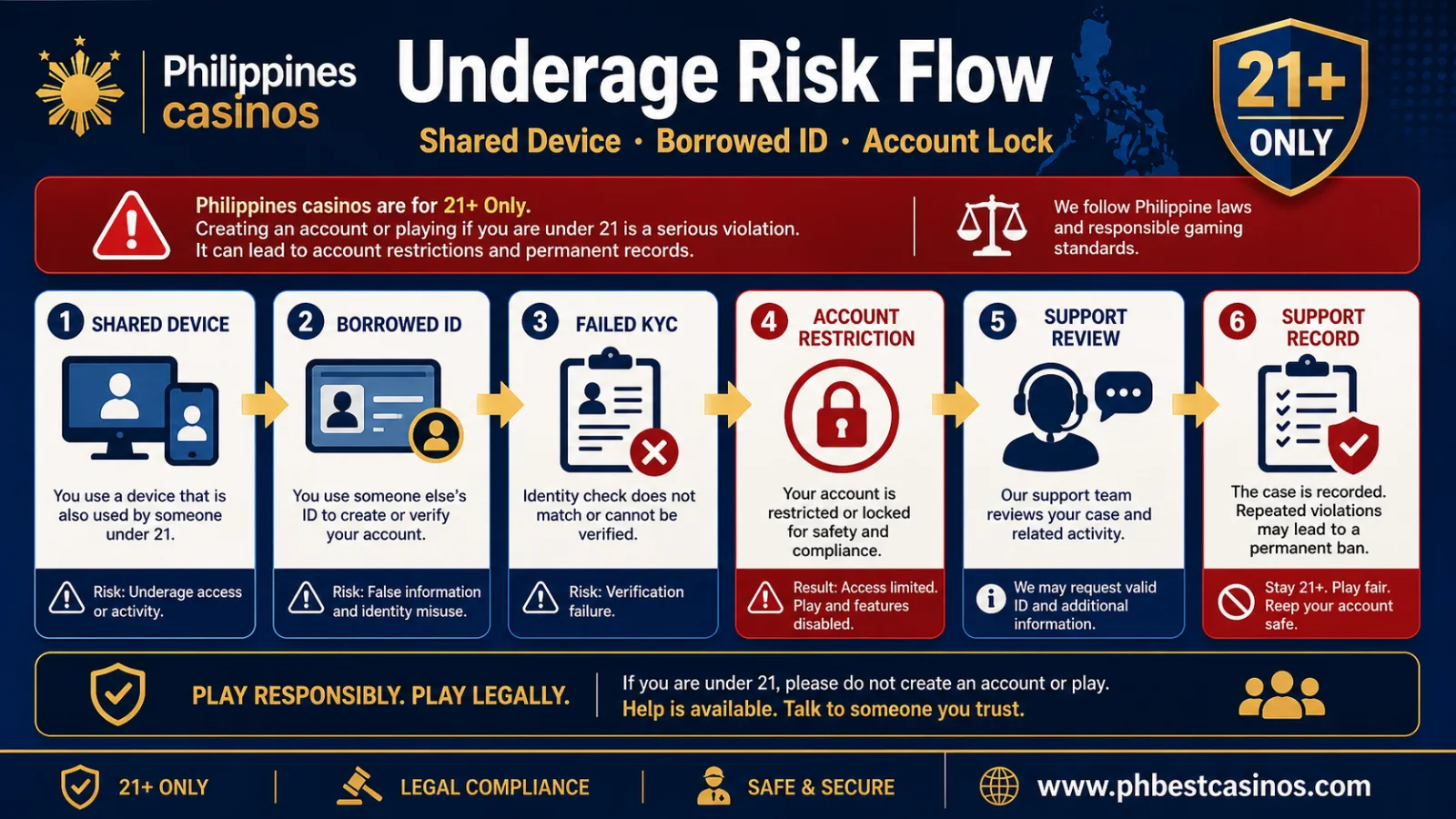
The riskiest situation is not only a minor registering. It is also a family member letting someone under 21 use an existing account, phone, wallet, ID or OTP. That can create account closure, returned-fund review, bonus cancellation, or a longer support case. A parent or guardian should also remove saved passwords and payment details from shared devices.
| Risk pattern | What can happen | Safer response |
|---|---|---|
| Underage registration | Account may be blocked and identity review may begin. | Stop use and contact official support for account closure or correction. |
| Borrowed ID | KYC can fail and the account may be treated as misrepresented. | Do not submit another person’s ID. |
| Borrowed wallet | Withdrawal or refund review can become complicated. | Use only the account holder’s own payment method. |
| Shared device | Saved passwords or OTP access can let another person play. | Log out, remove saved payment data and use device locks. |
| Agent sign-up | Third-party registration can hide the real account owner. | Use official registration only and keep your own records. |
What Parents, Guardians and Account Holders Should Check
If a family device has casino apps, browser logins, saved cards or wallet shortcuts, treat it as a real account-security issue. The goal is not to accuse anyone. The goal is to prevent an ineligible person from reaching real-money functions and to keep records if support must be contacted.
| Area | Check | Why it matters |
|---|---|---|
| Phone | Remove saved casino passwords and app shortcuts from shared devices. | A shared phone can bypass the account holder’s intention. |
| Wallet | Protect e-wallet PINs and transaction confirmations. | Payment access can create disputed deposits. |
| Secure recovery email and two-factor prompts. | Email access can reset casino passwords. | |
| Support | Keep any closure, refund or review ticket number. | A ticket is easier to follow than repeated chat messages. |
How This Page Differs From Other Site Pages
This page is not a general adult casino lifestyle article, and it is not a full KYC tutorial. The narrow task is eligibility: who can register, what proof may be requested, why account ownership matters, and what to do when underage or shared-device risk appears. For broader adult-play choices or KYC document fixes, use the related reading below.
FAQ
What is the legal casino age in the Philippines?
For real-money casino use, treat the rule as 21+ only. Operators may verify this through ID and KYC checks.
Can someone under 21 use a parent’s casino account?
No. Account sharing can create age, identity, payment and support problems. The account holder should secure the account and stop access from shared devices.
Do I need KYC before playing?
Requirements differ by operator and stage, but KYC is commonly required for withdrawals or account review. The safer approach is to understand KYC before depositing.
What if an underage person already deposited?
Stop account use, save receipts, contact official support, and ask for a written ticket or review path. Do not continue playing or open another account.
Source and Update Note
This article was updated on August 15, 2026 after reviewing PAGCOR’s PAGCOR Guarantee announcement, PAGCOR Guarantee, PAGCOR Responsible Gaming, and current Philippines casino registration search results such as CasinoPlus FAQ pages. Eligibility rules, KYC timing and document requirements can change by operator; verify the current account terms before depositing.
Related Reading
- Adult Online Casino Appeal Philippines
- Online Casino KYC Philippines
- Philippines Casino Law Mistakes Guide
- Casino Account Security Philippines
- Online Gambling Risk Guide Philippines